
Analyzing a company’s payments or transaction data enables us to identify which ones are fraudulent and which are not.
Knowing this classification, we can prevent them in our company.
The data science and machine learning platform Neural Designer helps banks, insurance companies, telecommunications companies, and retail companies detect and prevent these fraudulent payments.
Contents
Objectives
Fraud detection has become one of the biggest challenges for all companies.
Frauds pose significant problems for any business, and specialized analysis techniques are required to detect them effectively.
However, it is not easy to develop these techniques to detect fraud.
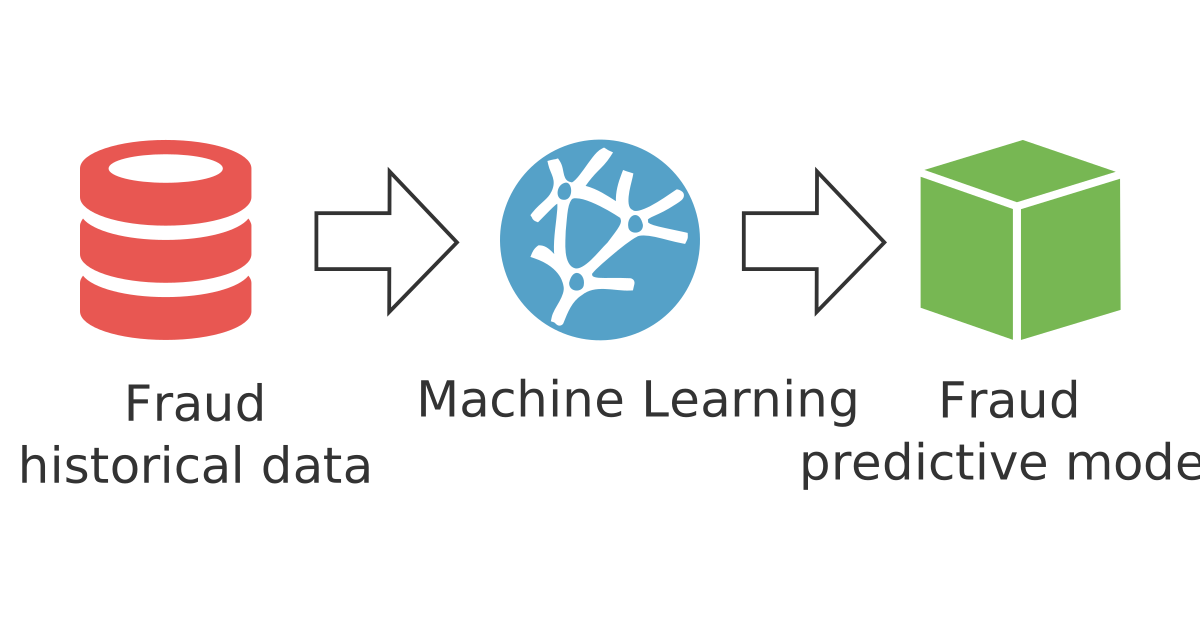
By harnessing the power of fraud data sets, companies can develop predictive models that enable the detection of any possible fraud.
Some of the factors that can influence committing fraud are the following:
- Buyer variables: Gender, age, education level, job category, nationality…
- Payment variables: Amount, country of origin, decline…
- Payment channel: Credit card, transfer, mobile phone, check…
- Stationary variables: Season, date, time…
- Etc.
The objective is to develop a program that detects and prevents future fraud.
To achieve this, it is essential to develop new methods that can identify the variables that make a payment fraudulent.
Benefits
The following are some of the many benefits of using machine learning for fraud detection.
STOP FRAUD QUICKLYDetect fraud quickly and early enough to take action. |
AVOID ECONOMIC LOSSESAvoid losses due to fraudulent payments. |
IDENTIFY COMPANY WEAKNESSIdentify the weaknesses that could lead to fraud and address them. |


Approach
Neural networks can detect fraudulent transactions, allowing us to avoid them.
The following graph illustrates an example of a neural network for fraud detection:
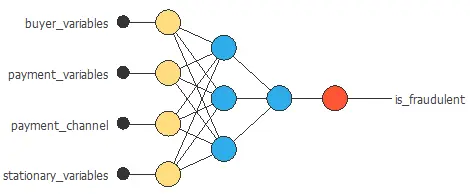
The data science and machine learning platform Neural Designer guides you through this process, allowing you to focus on your business rather than the details of machine learning.
Results
As we have explained before, fraud detection aims to determine which payments are fraudulent and which ones are not.
The following graph is obtained from the example credit card fraud detection. We can observe the rates both with and without the model.
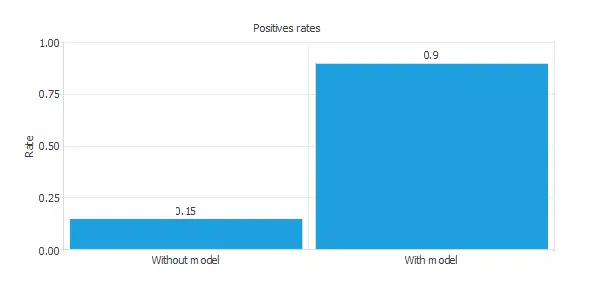
As expected, we can see how the positive rate increases. Initially, we have a rate of 15%, and after applying the model, we have a rate of 90%.
Conclusions
Machine learning enables companies to detect fraud promptly using available data.
Companies can leverage these techniques to mitigate losses resulting from fraudulent payments. They can also improve all the company’s weaknesses in the payment area.
Neural Designer utilizes artificial intelligence to identify the variables that determine whether a payment is fraudulent.