
Screen acute aquatic toxicity from molecular descriptors
This QSAR neural network estimates 48-hour acute toxicity toward Daphnia magna from eight molecular descriptors. It can support early chemical prioritization and data-gap review, while laboratory evidence, chemical identity and applicability-domain assessment remain essential for regulatory or safety decisions.
1. Industrial challenge
Acute aquatic-toxicity testing is resource-intensive, and chemical portfolios can contain more candidates than can be tested immediately. A QSAR model provides a transparent first-pass estimate from calculated descriptors, helping specialists decide which compounds need earlier review or confirmatory testing.
Rank descriptor-ready compounds for expert review and targeted 48-hour testing.
Use a consistent numerical screen to identify cases that deserve earlier attention.
Inspect descriptors, predictions, residuals and model version instead of relying on a black-box score.
2. Data set
The aquatic-toxicity.csv file contains 546 organic chemicals, eight calculated molecular descriptors and one experimental response. The UCI record reports no missing values.
| Descriptor | CSV field | Encoded information |
|---|---|---|
| Topological polar surface area | TPSA(Tot) | Molecular polarity |
| Hydrogen-bond acceptor surface area | SAacc | Hydrogen-bond acceptance |
| Hydrogens bonded to heteroatoms | H-050 | Atom-centred fragment count |
| Moriguchi logP | MLOGP | Lipophilicity |
| Reciprocal distance connectivity index | RDCHI | Molecular size and branching |
| Geary autocorrelation weighted by polarizability | GATS1p | 2D polarizability pattern |
| Nitrogen atoms | nN | Constitutional count |
| Electronegative carbon fragments | C-040 | Atom-centred fragment count |
The target LC50 is the concentration causing 50% mortality over 48 hours, transformed to −log(mol/L). The sign matters: a larger numerical value represents a lower lethal molar concentration and therefore greater acute toxicity.
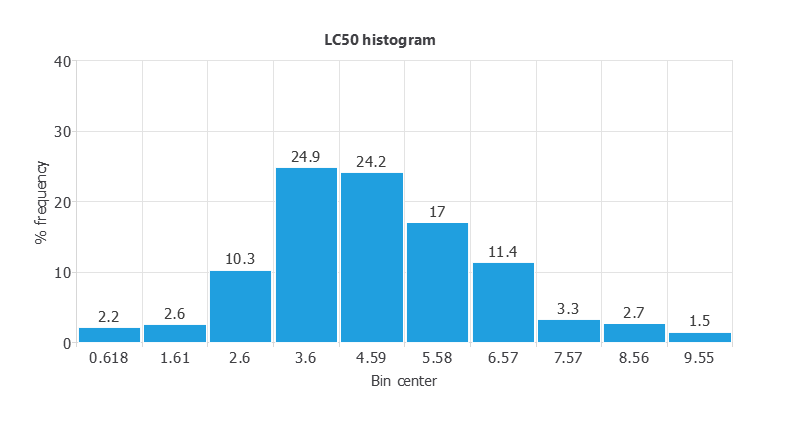
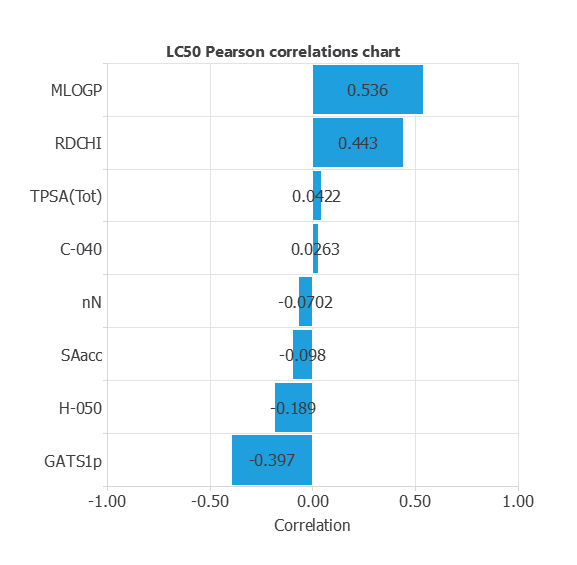
MLOGP and RDCHI have the strongest positive marginal relationships; correlation alone does not describe the nonlinear QSAR.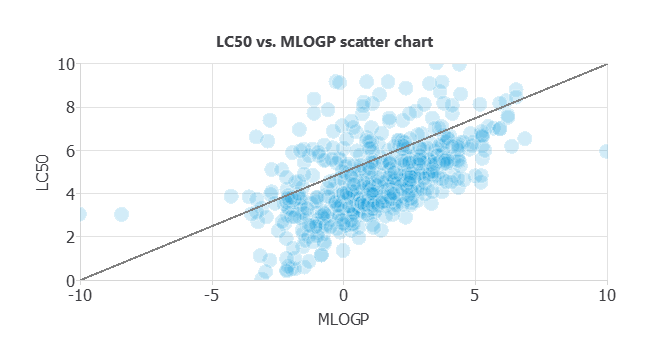
The broad scatter around the MLOGP trend reflects chemical heterogeneity and different mechanisms of action.
3. Model
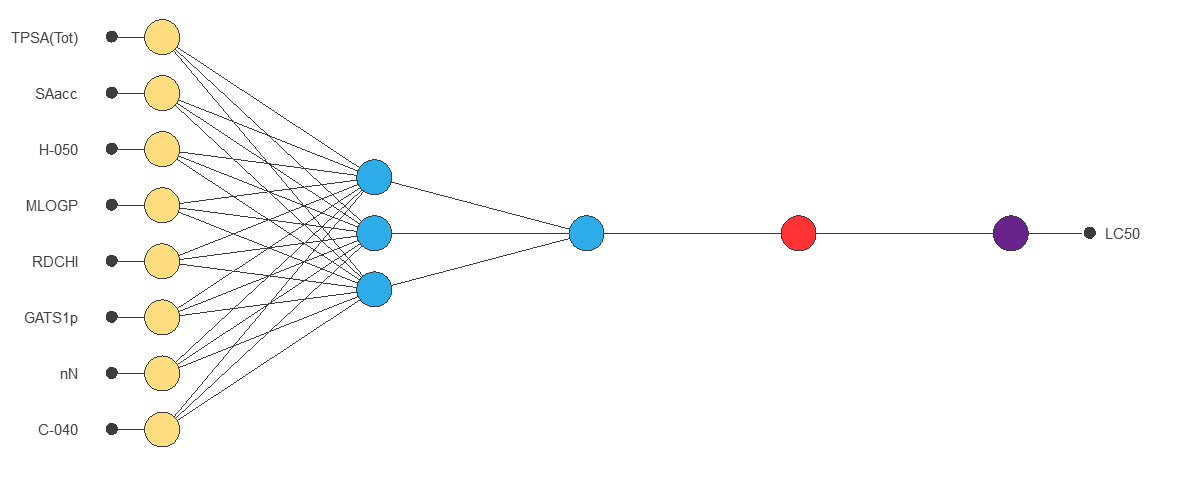
The final model keeps Neural Designer’s compact default architecture: eight standardized inputs, three tanh hidden neurons and one linear output neuron. The output is returned to −log(mol/L) and bounded to the observed response interval, 0.122–10.047.
The 8–3–1 network contains 31 trainable parameters. Its small size makes the exported calculation straightforward to audit and inexpensive to execute.
4. Training strategy
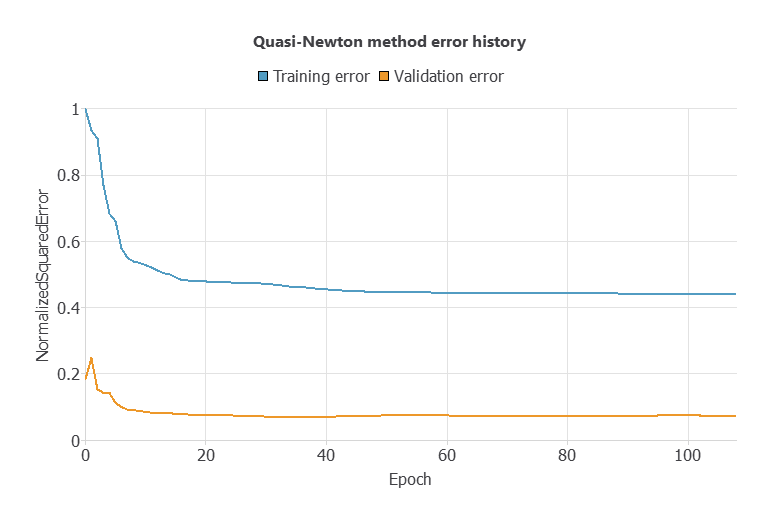
The network minimizes normalized squared error with L2 regularization weight 0.001. Quasi-Newton training stops after 109 epochs when the minimum loss-decrease criterion is reached.
| Optimizer | Epochs | Training error | Selection error | Stopping criterion |
|---|---|---|---|---|
| Quasi-Newton | 109 | 0.442 NSE | 0.074 NSE | Minimum loss decrease |
5. Model selection
No hidden-size search is retained in the final workflow. The three-neuron default network is used as a compact, reproducible baseline because increasing architecture complexity did not provide a stable improvement across sample assignments.
6. Testing analysis
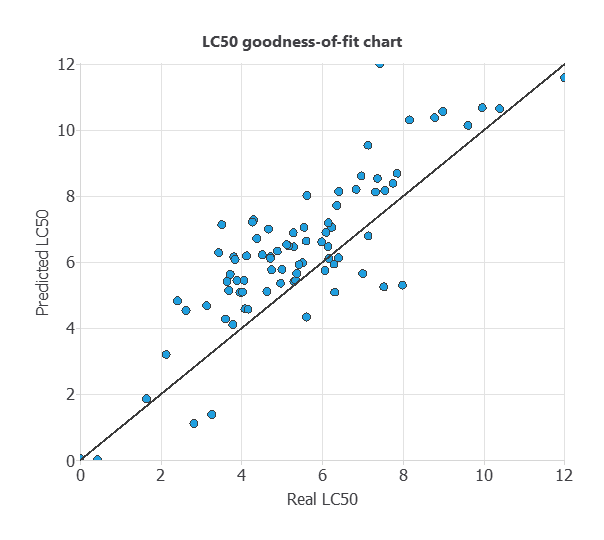
The final Python export was independently evaluated on all 82 rows marked as testing. Neural Designer’s determination value is the squared observed–predicted correlation. MAE, RMSE and bias quantify error directly in the logarithmic response scale.
| Testing compounds | Determination R² | SSE-based R² | MAE | RMSE | Bias | 95th-percentile absolute error |
|---|---|---|---|---|---|---|
| 82 | 0.7025 | 0.6619 | 0.76 log units | 0.96 log units | -0.05 log units | 1.80 log units |
The model reduces RMSE from 1.67 for a constant training-mean baseline to 0.96 log units. 75.6% of testing predictions fall within ±1 log unit, while the maximum absolute error is 2.82.
7. Model deployment
A credible QSAR workflow surrounds the neural calculation with chemical identity, descriptor reproducibility, applicability-domain assessment and expert review.
Try the QSAR screening model
Enter one molecular-descriptor vector. The calculation runs locally using the exact scaling, weights, output transformation and bounds from the exported Python model. Inputs outside the training range trigger a warning. This is not a certified regulatory or chemical-safety assessment.
Higher −log(mol/L) means a lower lethal concentration and therefore greater predicted acute toxicity.
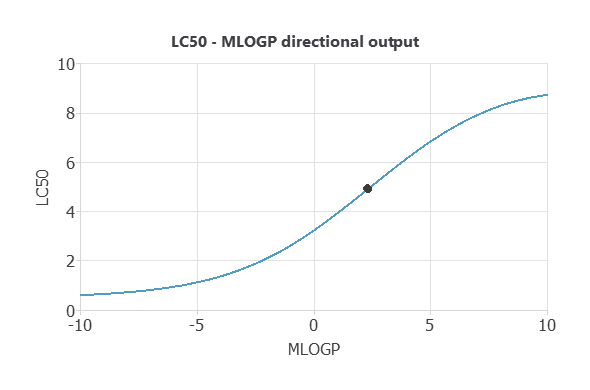
MLOGP directional output
This Neural Designer export varies only MLOGP while holding the other seven molecular descriptors at the reference operating point marked in grey. It shows the local response learned by the final network.
Download and reproduce
8. Scope and limitations
- The endpoint is 48-hour acute toxicity toward Daphnia magna, not chronic toxicity, another species or a broader ecological outcome.
- The 546 compounds are chemically heterogeneous. Different mechanisms of action limit what one global regression can represent.
- The CSV contains descriptors but no names, SMILES, chemical classes or explicit mode-of-action labels. Structural audit and scaffold-based splitting are therefore unavailable in this example.
- Univariate input ranges do not define a multidimensional applicability domain. Similarity or distance to training compounds should accompany every operational prediction.
- The 70/15/15 split is designed for interpolation and contains only 82 testing compounds. External chemical-series validation is still required.
- Experimental LC50 variability and repeated-measure uncertainty are not propagated into prediction intervals.
- The model compresses the response extremes and can underestimate highly toxic compounds.
- Descriptor software, calculation settings, preprocessing and model version must remain controlled; changing them can invalidate predictions.
- This example supports screening and prioritization. Regulatory and safety decisions require qualified review and appropriate experimental evidence.
References
- UCI QSAR aquatic toxicity dataset, 546 chemicals and eight molecular descriptors, DOI: 10.24432/C5SG7H.
- Cassotti, M. et al. Prediction of acute aquatic toxicity toward Daphnia magna by using the GA-kNN method, ATLA 42, 31–41 (2014).
- OECD principles for the validation of (Q)SAR models for regulatory purposes: defined endpoint, unambiguous algorithm, applicability domain, validation and mechanistic interpretation.
- Neural Designer testing analysis and model deployment.