Predict airfoil self-noise for faster aeroacoustic design decisions
This neural-network surrogate estimates scaled sound pressure level from airfoil geometry and wind-tunnel operating conditions. It provides rapid noise estimates for screening and sensitivity studies before committing to higher-fidelity simulation or acoustic testing.
Airfoil self-noise is relevant to aircraft, rotorcraft, drones, wind turbines, cooling fans and turbomachinery. A compact surrogate makes it possible to explore many operating points quickly, identify influential variables and focus expensive aeroacoustic work on the most promising designs.
1. Industrial challenge
This is an approximation problem. The model maps a measured frequency, angle of attack, chord length, free-stream velocity and suction-side displacement thickness to a continuous acoustic response: scaled_sound_pressure_level.
Potential users include aeroacoustic engineers, aerodynamicists, rotor and propeller designers, wind-energy teams, fan and turbomachinery engineers, NVH specialists and technical programme managers.
2. Data set
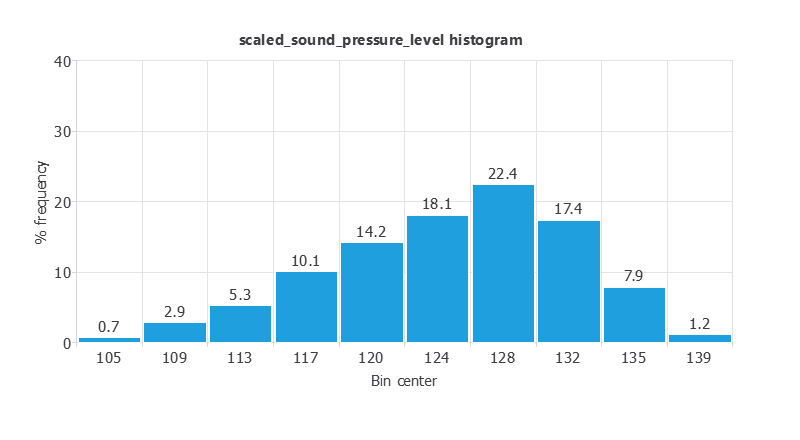
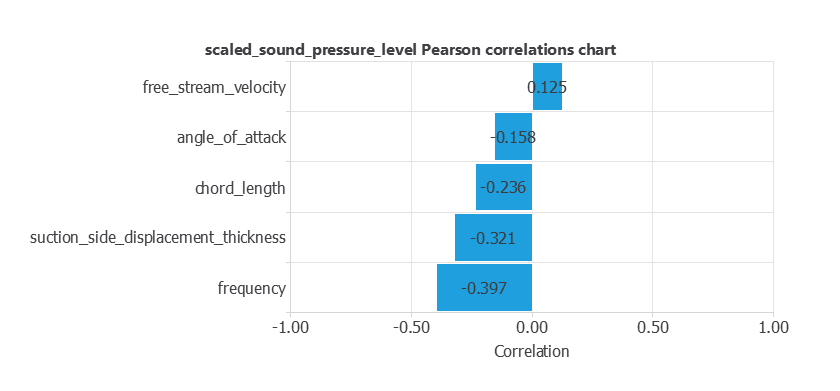
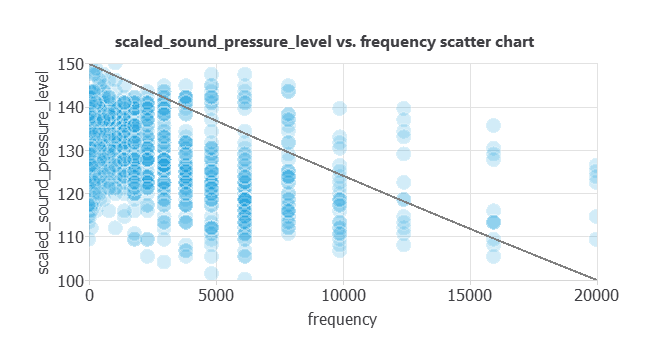
The Airfoil Self-Noise dataset contains 1,503 observations from aerodynamic and acoustic tests of NACA 0012 airfoil sections in an anechoic wind tunnel. It has no missing values and contains five inputs and one target.
| Variable | Engineering meaning | Role | Range |
|---|---|---|---|
frequency | One-third-octave-band centre frequency (Hz) | Input | 200 to 20,000 |
angle_of_attack | Airfoil angle of attack (deg) | Input | 0.0 to 22.2 |
chord_length | Airfoil chord length (m) | Input | 0.0254 to 0.3048 |
free_stream_velocity | Wind-tunnel free-stream velocity (m/s) | Input | 31.7 to 71.3 |
suction_side_displacement_thickness | Suction-side boundary-layer displacement thickness (m) | Input | 0.000401 to 0.058411 |
scaled_sound_pressure_level | Scaled sound pressure level (dB) | Target | 103.380 to 140.987 |
The current project configuration assigns 903 observations to training, 300 to model selection and 300 to testing.
3. Model
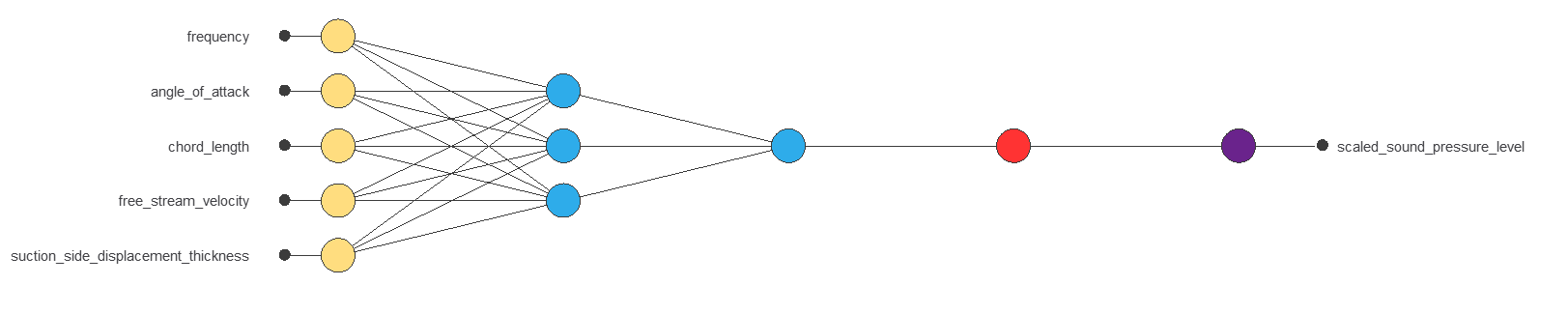
The initial network receives five mean-and-standard-deviation-scaled inputs, processes them with three tanh neurons and returns one linear acoustic output. This 5–3–1 baseline contains 22 trainable parameters and applies no output bounding.
4. Training strategy
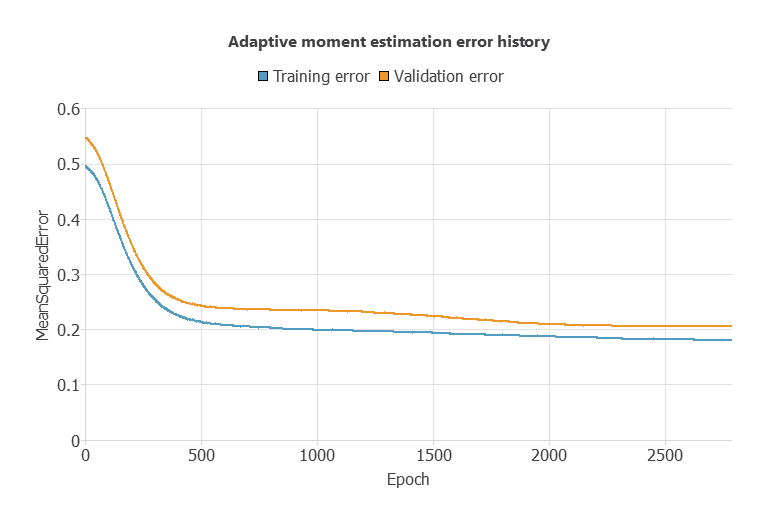
The baseline 5–3–1 network is trained with adaptive moment estimation (Adam), a learning rate of 0.001, batches of 1,000 samples and L2 regularization with weight 0.001. Training ran on NVIDIA CUDA and stopped after 2,785 epochs when the maximum number of selection-error increases was reached. The recorded final training and selection errors are 0.182 MSE and 0.207 MSE in the scaled training space.
5. Model selection
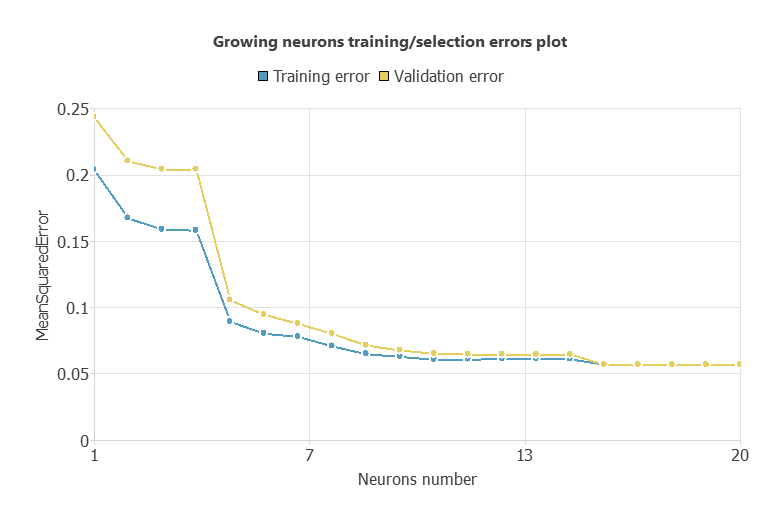
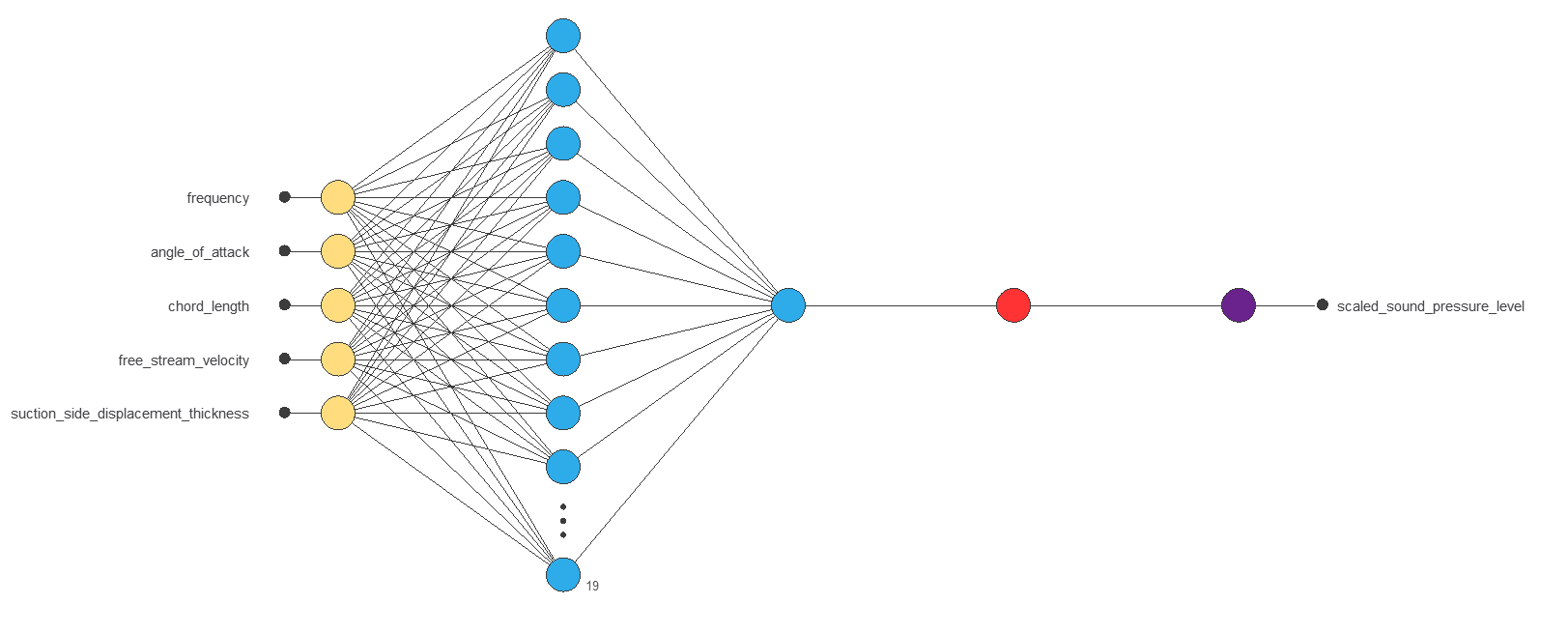
Growing-neuron selection evaluates hidden-layer sizes up to 20 neurons, using Adam with the same 0.001 learning rate and three trials per candidate. The selected architecture uses 19 hidden neurons, with reported optimum training and selection errors of 0.0569 MSE and 0.0565 MSE.
6. Testing analysis
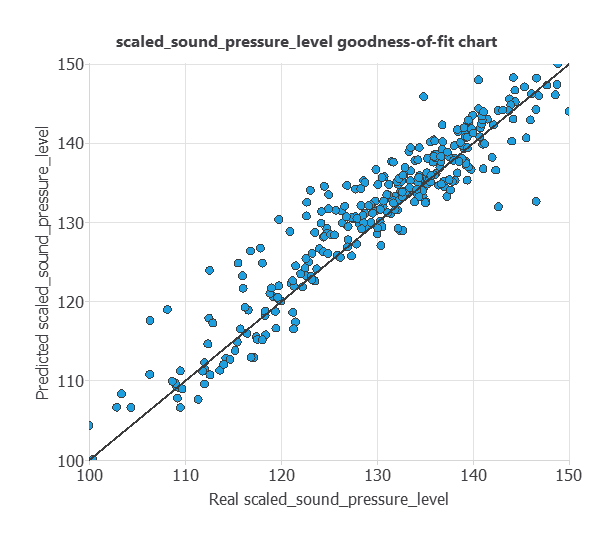
The exported Python model was independently recalculated on the 300 observations marked as testing. Neural Designer reports a goodness-of-fit determination of 0.8908 (squared prediction–target correlation). MAE and RMSE express the error directly in decibels.
| Testing observations | Determination | MAE | RMSE | 95th-percentile absolute error | Maximum absolute error |
|---|---|---|---|---|---|
| 300 | 0.8908 | 1.767 dB | 2.408 dB | 4.973 dB | 10.975 dB |
Compared with the previous quasi-Newton run, Adam substantially improves agreement across the represented acoustic range. The remaining largest errors still justify treating the model as an engineering screening surrogate rather than a certification tool.
7. Model deployment
The surrogate can support acoustic trade studies and test planning when inputs are checked against both their ranges and the combinations represented by the experiment.
Try the aeroacoustic surrogate
Enter a condition inside the experimental ranges. The calculation runs locally using the exact weights and preprocessing of the exported Python model.
Demonstration surrogate — not a certified control, protection or acoustic-certification system.
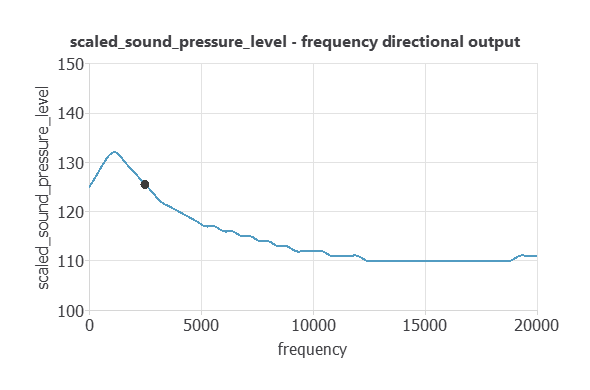
Directional response
The updated chart varies frequency around a reference condition of 5.4° angle of attack, 0.1524 m chord, 55.5 m/s free-stream velocity and 0.0043329 m displacement thickness.
Download and reproduce
The deployment package contains the current Python model. The project package contains the Neural Designer project and the matching CSV dataset.
Tutorial video
8. Scope and limitations
- The data describes NACA 0012 airfoil sections and the ranges shown above, not arbitrary modern blade or airfoil geometries.
- The model is a steady experimental surrogate and does not explicitly resolve individual self-noise mechanisms or transient flow.
- The target is scaled sound pressure level under the source experiment’s measurement definition; it is not a complete certification or community-noise metric.
- Predictions outside the observed ranges, or for a different tunnel, observer arrangement, surface condition or Reynolds/Mach regime, require new validation.
- A random row split can overstate performance on genuinely new configurations; grouped or campaign-level holdouts are preferable.
- Engineering decisions should be confirmed with appropriate aeroacoustic analysis, testing and applicable standards.
References
- Brooks, T. F., Pope, D. S., & Marcolini, M. A. (1989). Airfoil Self-Noise and Prediction. NASA Reference Publication 1218.
- Brooks, T., Pope, D., & Marcolini, M. (1989). Airfoil Self-Noise dataset. UCI Machine Learning Repository. DOI: 10.24432/C5VW2C.