
1.6. Image classification model
Image classification is a computer vision task in which an entire image is assigned to one of a predefined set of classes. Unlike a conventional classification data set, every input sample is a three-dimensional tensor of pixel values with the shape height × width × channels. The model learns the visual features that distinguish one class from another directly from those pixels.
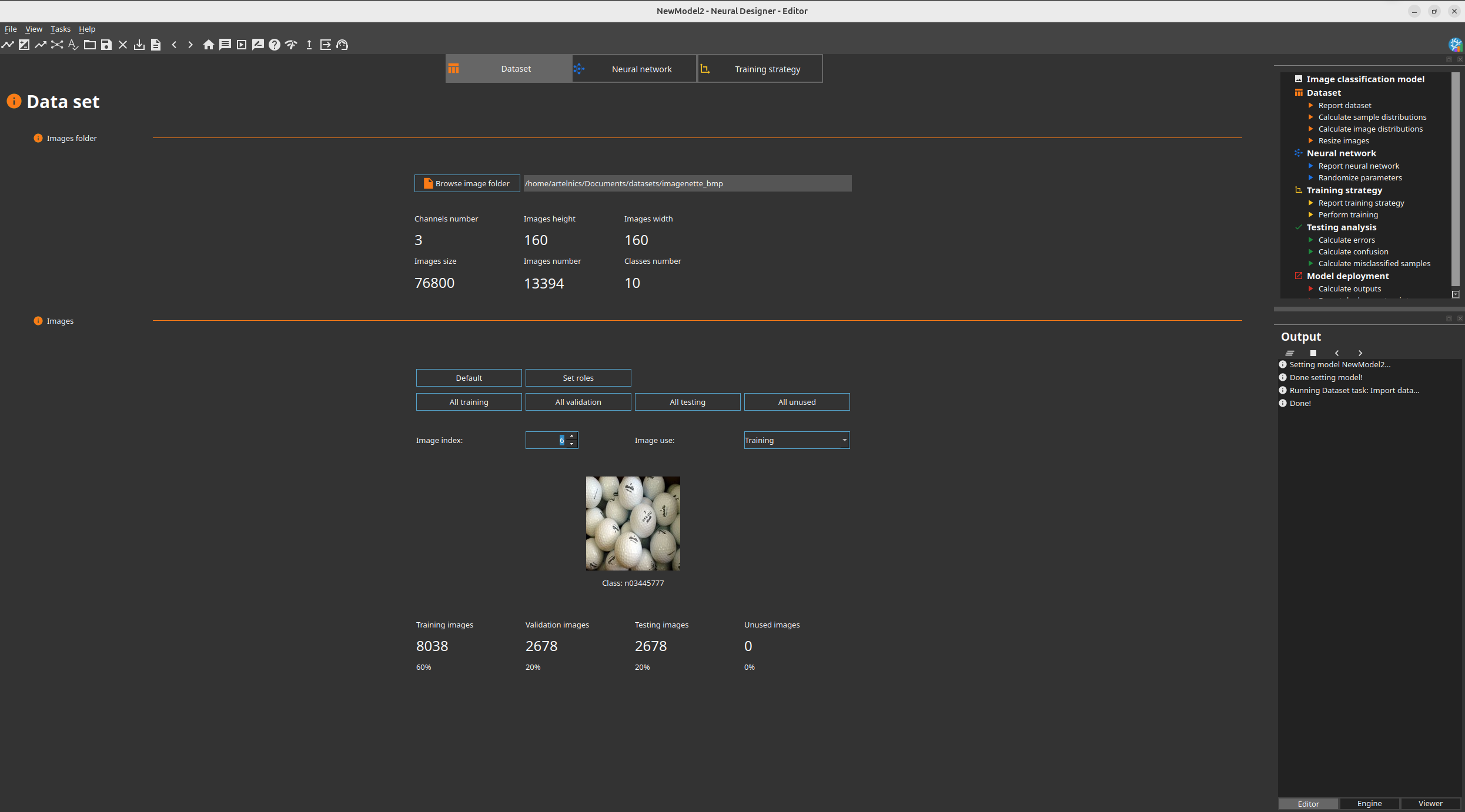
In Neural Designer, an image classification project combines an image data set with a convolutional neural network. Images are organized into one folder per class, and the folder names define the class labels. The data set must contain at least two non-empty class folders.
The image classification model processes the data through the following architecture:
- Image scaling: Pixel values are normalized with image min-max scaling.
- Feature extraction: One or more 3 × 3 convolutional layers with ReLU activation learn local visual patterns. Each convolutional block is followed by 2 × 2 max pooling.
- Classification: The extracted feature maps are flattened and passed to a dense ReLU layer.
- Output: Binary problems use a sigmoid output, while multiclass problems use a softmax output.
Cross-entropy is the appropriate loss for this task, and adaptive moment estimation is commonly used to train the network. The trained model can be evaluated with a confusion matrix and the corresponding binary or multiclass classification metrics.
Typical applications include handwritten character recognition, medical image classification, visual quality inspection, remote-sensing image analysis, and species or disease identification from photographs.
All model types