
1.3. Forecasting (or time series prediction)
A forecasting model predicts the values that one or more variables will take in the future, using the values that they, and possibly other variables, took in the past.
The data come as a time series: observations recorded at regular intervals, such as every hour, day or month. To train a neural network, the series is rearranged into samples. In Neural Designer, you choose the number of lags and the number of steps ahead: the inputs of each sample are the observations at the current time step and at the previous ones (the lags), and the targets are the values at the following time steps. After this rearrangement, a forecasting model is trained much like an approximation model.
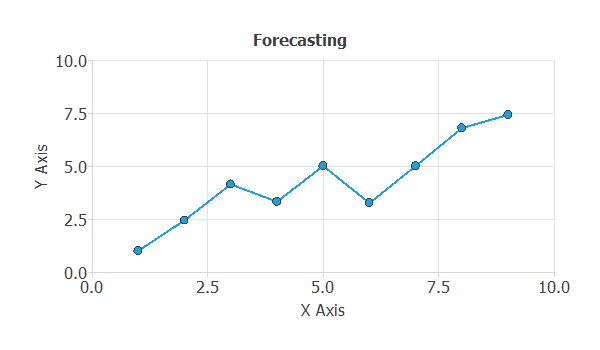
The following figure illustrates a forecast application: the model estimates the next value, yt+1, from the current value, yt, the previous one, yt-1, and so on.
For instance, a car manufacturer can forecast next month’s sales of a model from its sales in previous months, its recent marketing actions and macroeconomic indicators.
A forecasting model is only useful if its predictions hold beyond the period it was trained on. For that reason, it is good practice to test it on the most recent part of the series, which the model has not seen during training.
All model types