
1.2. Classification (or pattern recognition)
A classification model assigns each sample to one category out of a fixed set. The inputs describe the sample, for example the measurements taken from a tumor or the activity of a customer, and the target records the category it belongs to.
Rather than returning a bare label, a neural network for classification estimates, for every class, the probability that the sample belongs to it given the values of its inputs. The predicted class is then the most probable one or, in binary problems, the one chosen by a decision threshold. Probabilities say more than labels: they show how confident the model is, and they let you balance false positives against false negatives.
In the following figure, each sample is described by two inputs, x1 and x2, and belongs to one of two classes, drawn as circles and green squares. The model has to find a boundary that separates the two groups.
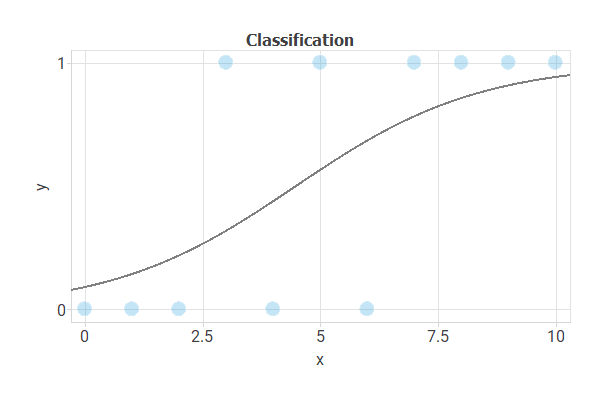
As in approximation, what counts is the performance on samples that the model has not seen: a boundary that wraps tightly around every training point usually classifies new data worse than a smoother one.
We can distinguish between two types of classification models:
Binary classification
In binary classification, the target variable is usually binary (true or false).
Some examples are to:
- Diagnose breast cancer from fine-needle aspirate images.
- Reduce employee attrition.
- Increase the conversion rate of telemarketing campaigns in banks.
- Predict the probability of default of credit card clients.
- Detect diseased trees from remote sensing data.
- Target donors in blood donation campaigns.
- Diagnose acute inflammations of the urinary bladder.
- Predict customer churn in telecommunications companies.
Multiple classification
In multiple classifications, the target variable is usually nominal (class_1, class_2, or class_3).
Some examples are the following:
All model types