
1.4. Anomaly detection
Anomaly detection identifies samples that depart from normal behavior. In Neural Designer, this model uses an auto-associative neural network to reconstruct its own input variables. It learns from normal training samples; it does not need a separate target variable for training.
The following figure illustrates the reconstruction network used by the model:
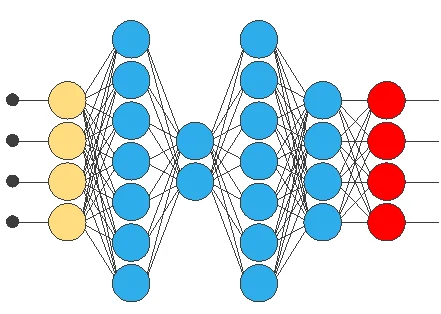
The difference between a sample and its reconstruction is an error score. Samples whose score reaches or exceeds the anomaly threshold are flagged for review. Neural Designer can calculate a threshold from normal training errors or use a threshold chosen by the user.
Typical applications include spotting unusual sensor readings in industrial equipment, abnormal ECG measurements, and deviations in process or environmental data.
Prepare normal samples for training and reserve separate samples for testing. An optional Evaluation variable can hold known labels (0 for normal, 1 for anomalous); it stays out of the model and is used only to assess detection results.
For this model, Neural Designer provides tasks to inspect sample reconstructions, calculate anomaly thresholds, evaluate detection tests and ROC curves when labels are available, detect anomalies in a new CSV file, and export an anomaly detector.
Explore three Anomaly Detection examples with saved task results:
- ECG anomaly detection — Research benchmark on ECG5000 beat classes from one recording.
- Bearing anomaly detection — Four-bearing vibration feature review.
- Hydraulic system anomaly detection — Hydraulic cycle monitoring with a training-derived threshold.
All model types